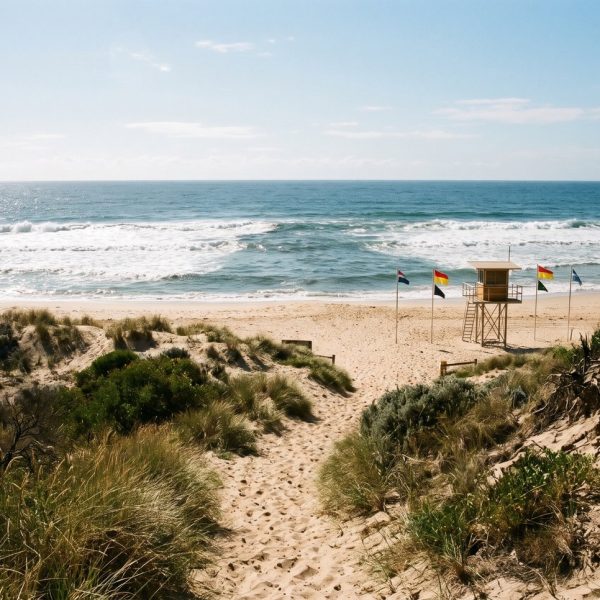
The calmest-looking patch of sea on a busy beach is sometimes the most dangerous. Rip currents are behind a large share of lifeguard rescues worldwide, and most people caught in one simply did not recognize it from the sand. Learning how to spot a rip current takes a few minutes, costs nothing and can change the course of a holiday. Here is what to look for, what to do if one catches you, and how warning systems differ when you travel abroad.
What a rip current actually is
When waves break on a beach, the water they push ashore has to find a way back out. It often does so through a narrow channel, flowing seaward at speeds that can outpace even strong swimmers. That channel is a rip current. It does not pull you under, but it can carry you away from shore surprisingly fast, and the panic that follows is what makes it dangerous.
The Wikipedia entry on rip currents explains the physics well, including why they tend to form near sandbars, piers, jetties and rocky outcrops. In short, anywhere the shape of the seabed concentrates returning water is a candidate.
How to spot a rip current from the beach
Before you set your towel down, take five minutes to watch the water from a slightly raised spot, such as a dune path or the top of the beach steps. Look for a gap in the line of breaking waves, where the surf seems oddly flat. Look for a strip of darker or murkier water running out from the shore, often because it is deeper or carrying sand. Watch for foam, seaweed or debris moving steadily away from the beach, and for a choppy, rippled channel between calmer areas.
Not every rip shows all of these signs, and some are almost invisible at certain tides. That is why the most reliable approach is to swim at beaches with lifeguards and to stay between the flags they set out. The US National Weather Service rip current safety pages include clear photos and daily risk forecasts for American coastlines, and they are worth a look before any beach trip.
Rip tide vs rip current: clearing up the names
You will often hear people say "rip tide". Strictly speaking, the rip tide vs rip current question has a simple answer: the correct term is rip current. Tides can make rips stronger or weaker, especially around low tide, but the current itself is driven by breaking waves, not by the tide. Undertow is different again, a short backwash along the bottom near the shoreline that knocks you off your feet but does not carry you far out.
How to escape a rip current if you are caught
Knowing how to escape a rip current comes down to staying calm and not fighting it. Swimming straight back toward the beach against the flow will exhaust you quickly. Instead, float on your back to conserve energy and keep your head above water. Swim parallel to the shore, out of the narrow channel, then angle back toward land once you feel the pull ease. If you cannot swim out, keep floating and raise one arm while calling for help so lifeguards can see you.
Most rip currents are narrow, often only a few meters wide, and many circulate back toward the surf zone. Floating buys time. If you see someone else in trouble, alert a lifeguard or call emergency services and throw them something that floats, rather than swimming out yourself.
Beach safety tips when you travel abroad
Flag systems and warnings vary from country to country, and they are not always in English. In Australia and the UK, red and yellow flags mark a patrolled swimming zone. In much of Europe and the US, a red flag means dangerous conditions, and in some places a double red flag closes the water entirely. Learn the local words for rip current before you go: "corriente de resaca" in Spain, "baïne" or "courant d'arrachement" on the French Atlantic coast, "agueiro" in Portugal and "corrente di risacca" in Italy. Knowing a few phrases makes signage and lifeguard instructions far less confusing, and it pays to brush up on the languages of the top summer travel destinations before you pack.
Some general beach safety tips apply everywhere. Never swim alone, keep children within arm's reach in the water, avoid swimming near piers and rocks where rips often form, and ask the lifeguard about conditions when you arrive. Families planning a trip will find more practical advice in this guide to beach safety tips for spotting rip currents with children.
Make it part of your beach routine
Experienced surfers and lifeguards all share one habit: they look at the water before they get in. Make those few minutes of observation part of your arrival routine, the same way you find shade or apply sunscreen. Point out the signs to children so they learn to read the sea themselves.
Once you know how to spot a rip current and how to respond, the ocean becomes less intimidating, not more. You will choose better places to swim, recognize danger early and spend more of your holiday doing what you came for, enjoying the waves.